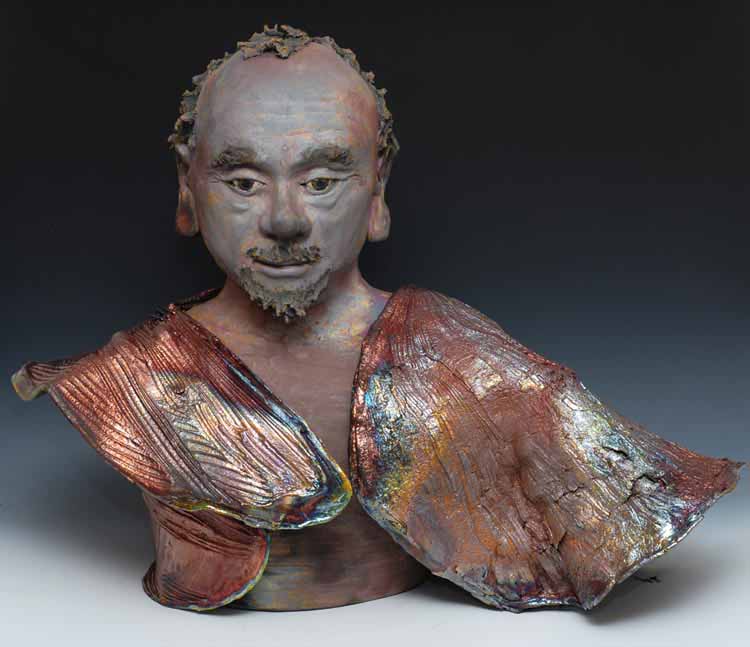
I visited the raku studio of artist and zen teacher Anita Feng in late August at the height of Indian summer. The trees had not yet caught fire, but the air held an expectant shimmer. Within a few weeks the leaves would deepen and turn, and that abalone glaze particular to this latitude would paint the city in subtle iridescence. If there is a season for raku, it is Autumn. This ceramic art form relies upon the drastic extremes of water and fire. It epitomizes the dynamic of change and working skillfully with change, and in this way it is the perfect parable for Zen practice.
I had met Anita earlier in the year, after seeing her Buddha sculptures in various galleries and visiting the Blue Heron Zen Center, where I very much enjoyed her clear-eyed Dharma talks. I was intrigued by her complex background as a poet, a potter and a 30- year practitioner of Zen in the Korean tradition. As a poet she has won many prestigious awards, including an NEA grant and the Pablo Neruda Prize and published two books of poetry. Much of her pottery background has been devoted to the making of ocarinas, the diminutive bird-shaped flutes of ancient times. I was very curious to know how she wove the threads of these different paths into her current focus as “The Buddha Maker.” As well, how she reconciles the traditions of devotional practice with a modern audience. I caught up with Anita as she took a break from preparations for Art in the Garden, an annual art and sculpture event held at Bellevue Botanical Gardens. We talked for many hours, and this interview is a combination of notes, memory, and email.
IJ) The power of Buddha images traditionally lies in their impersonality. The faces are based on years and years of archetypes, repeated and refined over centuries. In devotional statues the emotional element of mirroring, of liking what looks like us, is complicated by the idea of holiness or aspiration. In fact, we don’t really want the Buddha to be just like us. In contrast to the requirements for presidential candidates, we don’t judge the Buddha’s success by whether he would be a great guy to have a beer with. That not-having-a-beer-with characteristic is part of the deal. The statue is clearly not us. It is an idealized extreme. If we are from Northern European stock or African or Hispanic the Asian/Indian character of the features is not ours. This can be alienating. Alternatively we can experience it as restful–the burden of being personal is lifted, and we can surrender to something outside of ourselves.
One of the most difficult things to do in sculpture is to create a face that is universal, that does not create a subjective reactive “I don’t/do like you” response in the viewer. When a human being sees a face, whether on a real person or in a work of art, an immediate relationship arises. What guides you as you create the faces of your sculptures, and does your process or state of mind change as you work on the body?
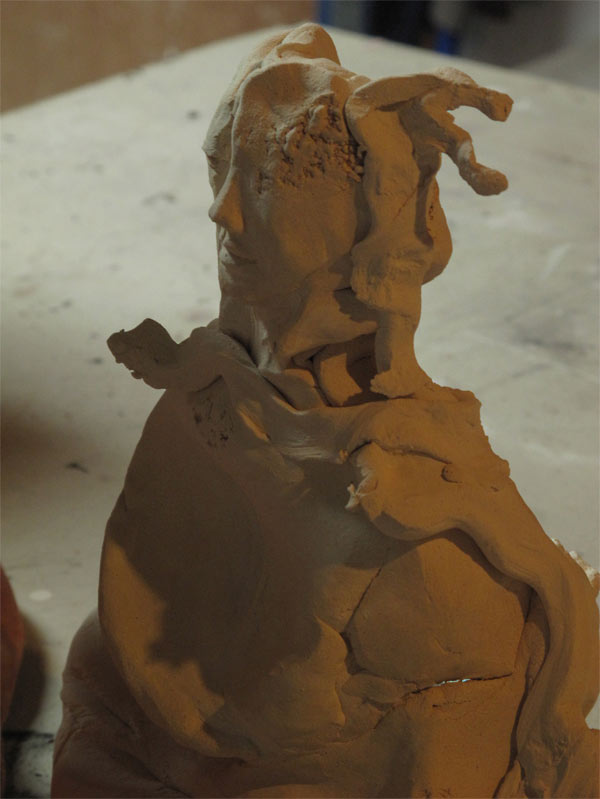
AF) There is a way in which iconography, indeed in which history, prettifies or re-invents the past to teach and/or inspire (or divert!) the following generations. As Zen students, as students of our own particular moment world, we have the responsibility to sort out inventions and embellishments from the root teacher/teaching.
For me, in sculpting a face, I am looking for a meeting place of the particular with the universal. There is, in all iconography, an ideal that is presented. (ie.- calm, equanimity, peace, centeredness). But from the teachings and enlightened experiential wisdom that has been passed down over the generations, the only way these qualities can arise and be authentic is in the present world/moment experience. So I create faces that reflect our/my world, but it should be said, this is a world that contains all the references of the past as well. We are, as creative creatures, a composite of past, present and future, all together.
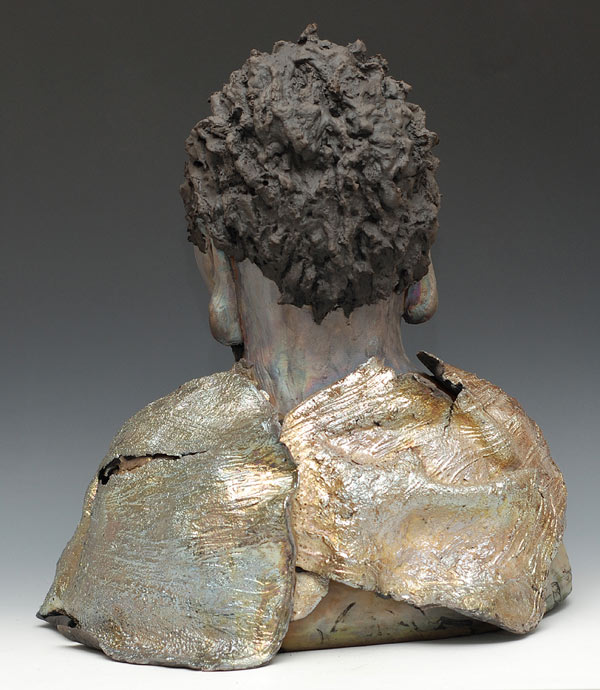
In the physical act of working the clay I reflect these two essential components (moment world, infinite time and space) in this way: the fleeting, sometimes ragged and torn movement suggested in the body/robes…. paired with the enduring, infinite stillness within the calm face. These faces may be sad, happy, or in between — but all mean to suggest a still equanimity. There is something wonderful and necessary about having an idealized image that inspires us to think that equanimity is possible. What is dangerous is when we start to believe “equanimity looks like this.”
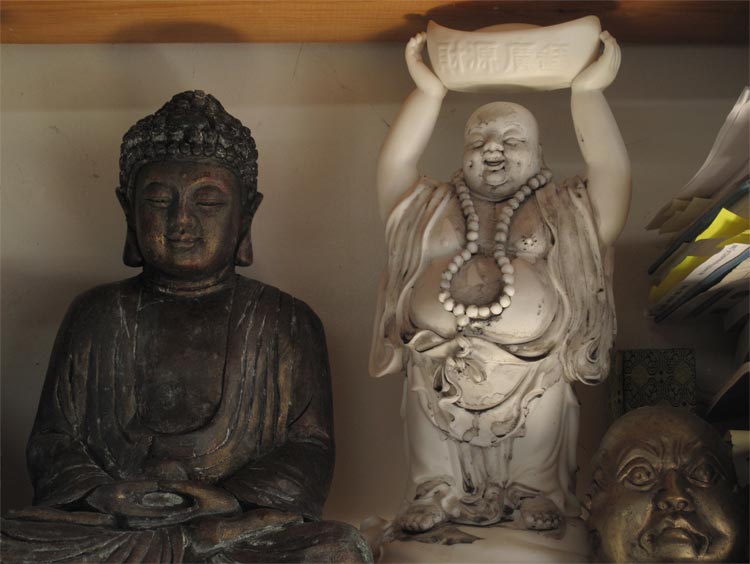
IJ) Where and how do you draw your line between tradition and innovation? I have noticed that you have discarded many of the familiar aspects such as the stylized hair and dome-like stupa on the top. The robes can be completely wild.
AF) I don’t know if I draw any real lines between tradition and innovation. I do feel it’s important to reach back and honor aspects of the tradition where it seems to fit and serve. If the figure becomes too abstracted from the archetype people don’t have an anchor. I have chosen to keep the stylized ears, because it is an easily recognizable feature of a Buddha, but also because it points to a very real person, a privileged wealthy youth who became Buddha –with his ears elongated from the weight of heavy earrings.
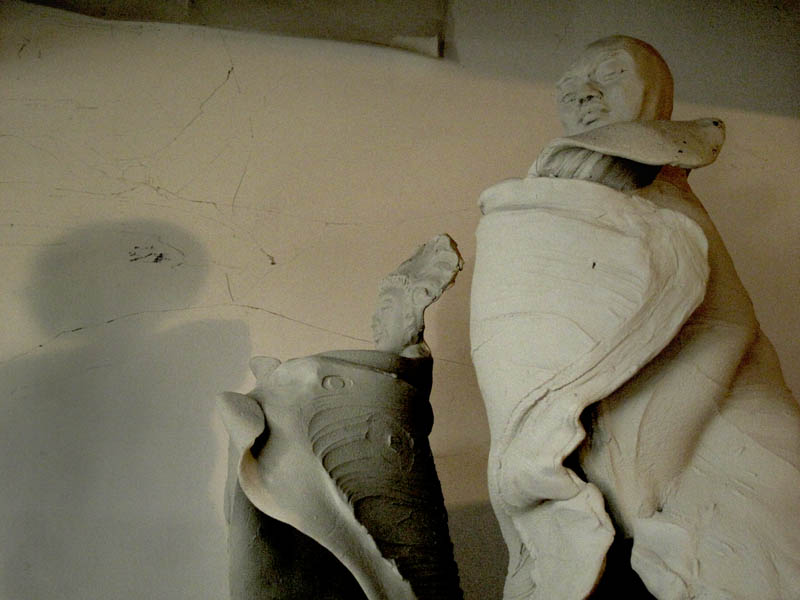
 The Ears [Read more…]