Iskra Fine Art

  • Prints
    • Colorbath (NextGEN)
    • ColorBath
    • Industrial Pastorale
    • The Scaffold
    • Industrial Strength | Urban Landscape
    • The Floating World
    • Construction/ Reconstruction
    • The Natural World | Botanical Prints
    • Infrastructure
  • Drawings
    • Pencil Drawings: Pandemic Pause
    • The Waterglass
    • Drawings in Dust 1
    • Drawings in Dust 2
    • The Garden
    • Signs & Symbols
  • Photography
    • NextGen Western Landscape
    • Western Landscape Photography
    • Construction Sites | Photography
  • Mixed Media
    • Modern Botanical | Mixed Media on Plaster
    • From the Sea | Water Paintings
    • Sleep Studies
    • The House | Archive
  • Journals
    • Wayfinding
    • Tacoma Suite
  • Shop
  • About
    • Contact
  • Blog
You are here: Home / Archives for Essays

Collage Life, Refiguring Art and Friendship in the Pandemic

August 30, 2020 by Iskra 10 Comments

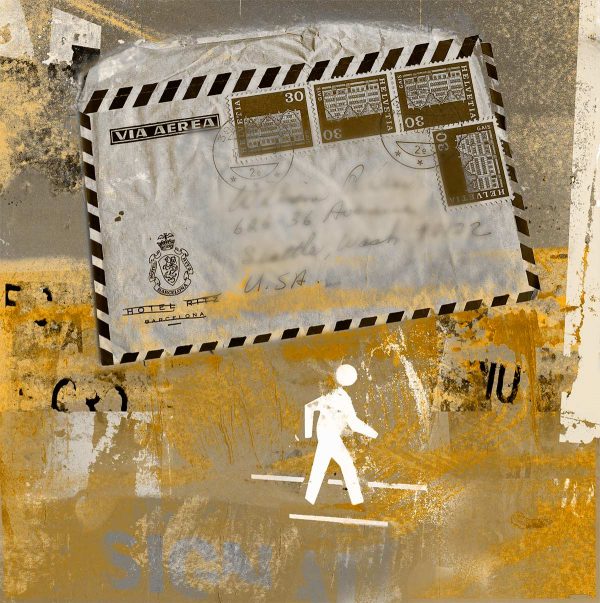
Correspondent Letter collage by Iskra

The Correspondent, ©Iskra Johnson

(This late summer dispatch breaks all the rules of “newsletter.”  August is a time of slow thinking and revision, thought and word pasted and lifted and re-placed in an order based on considerate disorder and association, ie. on the structure of my mind. If there is no news (I have been immersed in art history which is by definition old news) there is still, however a “letter.” This post is about letter writing itself, and how personal correspondence can mean the world and re-make the world of our creative lives. Settle into a deep chair, with good light or a rustling tree and a cat at your feet. Consider that the post office would love it if you bought some stamps.)

On this particular morning, about 214 days since the pandemic became the official organizing principle, I am sitting at my kitchen table drinking Earl Grey and looking at a stack of books and magazines and letters accumulated since spring. In April my friend Jennifer began sending me her monthly Poetry subscriptions along with pages torn from magazines. Every page is pre-read and annotated with trenchant scribbles in the margins, curated personally just for me. Jennifer has reached the place in life of casting off. I am still bringing things into my house, desperate for distraction, but seem to have confused doom scrolling and pulp novels with The Great Books. I gather romances from the Little Free Libraries on my walks and have not made it beyond chapter 1.

When the first poetry letter arrived I was ecstatic. Mail! Brown paper and string! And delivered by a man in blue socks and shorts, as though it was 1958, a sandwich meant Mayonnaise on Wonder Bread, and Lassie the Collie still roamed the earth in his white socks, teaching us what heroes look like. The letters have ignited a connection that feels

[Read more…]

Filed Under: Collage, Digital Collage, Essays, Photocollage Tagged With: collage art, collage life, Curation, history of collage, Pandemic art, Pinterest critique, W.H. Auden, women friendships

A Night at the Opening of the Seattle Asian Art Museum (Snow Moon)

February 17, 2020 by Iskra Leave a Comment

There is a perfume called Museum, available at discreet boutiques. When you daub it behind your ears pearls attach, shimmering and pendant from tiny diamonds. Your neck grows long and swans into the darkness of evening above a silk dress sewn from the sky of early dusk. Every word spoken, from the mouth delicately suspended above the long white neck, has the quality of pronouncement. What your eyes light upon is anointed, pedigreed, and placed on a pedestal. This girl with the pearl is the ultimate docent. She has ridden alongside the robber barons and hauled the world’s worth home, there to catalog objects that always aspired (without knowing it!) to become artifact. She finds it charming to be confused with the girl in the Vermeer, the girl hanging in the Louvre and adored by millions.

Because of the internet, which appears in the palm of my hand every five minutes, I cannot help but compare myself to that Girl. Behind my ears is simply the after-scent of shampoo from Walgreens. I wear jeans and a puffy jacket, and sterling silver ornaments, buried in unstyled hair. If I was to de-acquisition a chunk of statuary and remove it from its pedestal for my personal collection I would be hauled off to jail and my friends would leave me. Nothing says have and have-not like a museum.

The Seattle Asian Art Museum tries to meet this situation head on, so to speak, while being appropriately oblique. In the Room of the Beheaded Buddhas, each head of the half-dozen is clearly displayed as a trophy. The only thing missing is the bloodied chisel. Says the placard: These fragments of figures also reflect the difficult reality that the historical art market supplied such small, portable and alluring objects to collectors under the circumstances of colonial expansion and other forms of cultural imperialism. Explore our smartphone tour for further discussion. Should you flinch at the phrase “cultural imperialism,” remember that the museum is not running for higher office. It is simply telling it like it is.

[Read more…]

Filed Under: Essays, Meditation & Buddhism, Object Lessons: Essays and images inspired by "A History of the World in 100 Objects." Tagged With: Chinese Snuff bottles, Contemplations of Asian Art, Iskra Review of Art and Culture, SAAM, SAAM opening night

Solstice Meditations on a Year of Chiaroscuro

December 22, 2017 by Iskra 5 Comments

Lake Country Elegy print by Iskra
Lake Country Elegy, mixed media print. Available on SaatchiArt. © Iskra Johnson

“All that is solid melts into air.” – Marshall Berman

“Stories are for joining the past to the future. Stories are for those late hours in the night when you can’t remember how you got from where you were to where you are. Stories are for eternity, when memory is erased, when there is nothing to remember except the story.” – Tim O’Brien

My studio window faces east, and in the winter a plume of silver rises from my neighbor’s chimney, blooming upward against the dark scrim of evergreens until it blends into the clouds above the little lake hidden beyond. Although it is beautiful, I can’t look at an arabesque of smoke these days without thinking of California and the fires. In the morning as I sit to meditate and be grateful for the day my thoughts run beyond the borders of the visible. I shut my eyes and my mind fills with headlines, a tickertape of catastrophe.

2017 brought a harrowing onslaught of natural and unnatural disasters, from tropical storms to earthquakes to fires to the drastic political campaign to dismantle our national parks. Some disasters seem distant; others, depending on the luck of personal geography, may infiltrate every pore of your skin and fill your hair with ash. I live in the still-damp terrarium of the Pacific Northwest, but my family’s roots are in California. All through this late summer and fall I was on high alert with worry, thinking of my cousins. In Seattle and the islands the sunsets were spectacular. The smoke from the northern fires in Canada and to the East filtered into our native silver light and turned it tangerine. Leaf-shaped ash settled on the windowsills.

As the fires in Sonoma spread, an email chain of 19 cousins sprang up to share news of evacuations. In Santa Rosa a cousin’s house and car burned to the ground. In the midst of worry and sorrow we turned instinctively to history for solace and began to share the legacy of family stories. Each telling of the family myths had been remembered differently, and changed when retold. Did grandma McCarthy really fall out of bed when the San Francisco earthquake struck? Do we believe that patrician matriarch with white hair was ever thirteen, and wringing her hands in the garden and reciting poetry to calm herself down – or is that Irish hyperbole? The fires came. The family lived in tents in Golden Gate Park. For how long, a day or a week or months is unclear, but we needed to believe this story, because it meant that there had been worse, a fire and an earthquake, and we come from a resilient line of people who survive catastrophe, and quote poetry while doing it.

The fire stories in the news all recite a version of the same moral tale. The person, chased by flames, throws a few things into a car or backpack as they run for it. They lose everything, but they are grateful for their lives because that’s what’s important. Those of us reading are prodded to nod in agreement: yes, look how their values clarify in the heroic emergency, all that matters is the life force and continuing on. And yet. In the lengthening thread of my Irish cousins’ correspondence about catastrophe, objects began to emerge. Everyone, it seemed, had some heirloom tucked away, and we began to trade pictures. A sterling hairbrush, a mirror. Grandfather’s copybook. A gold watch and chain inscribed with three different initials dating from 1848. Byrne, Rooney, McCarthy: Éire. An entire island comes attached to these names.

Objects matter. They hold memory, or, as Fennel Hudson put it, “fine things are reservoirs for the heart,” whether they are engraved in gold or ghosts of silver halide on stained paper.

Heirloom study, mixed media by Iskra
Heirloom Study One, from the McCarthy trove. Mixed media print, size variable, available in my shop. © Iskra Johnson

As today’s younger generation embraces a vogue for minimalism and non-attachment, consider that it may be born of necessity as much as fashion. The environment is imploding, the seas are rising, the idea of a “job” or “security” or “family” has been replaced by gig, by reinvention, and by never getting married because you never know when change might happen. At the same time as all that is solid melts into air, global culture has embraced images as never before. How many thousands of times a day does someone say “just like a movie,” “postcard perfect,” “Pictures or it didn’t happen….” The line between real and replica has never been less clear. You could call this delusion, or you could call it a fine and logical survival mechanism. It is human to want something to hold onto, and when the actual world is looking shaky the idea, the image, may be that something. If you are standing in the smoking ruins of your home it is the idea of home that will move you onward to rebuild.

All the same, I do not want to live in a world built purely on sentimental remembrance. Take the Arctic Wildlife Refuge (oops, sorry, it’s been taken already) or the Bears Ears National Monument (oh, that too, hieroglyphs and all–). Wilderness is our image bank as a collective consciousness. It’s the idea of the wild and all that it contains. But if wilderness becomes a denuded moonscape of oil rigs the idea itself will die, and with it the collective soul. Then we have only the Disney version sold back to us as a movie, in a sorry attempt at pacification through images and a soundtrack to consume.

My recent work is preoccupied with this tension between the ideal, what I think of as the archetypal food of the soul, and the unironic in-your-face calamity of the present. I am never drawn to overtly political art, but as a politically engaged person it is always present as subtext in the images I make. Politics is power. The distribution of power and its effects on the landscape change what we see and how we see it. As what we took to be solid melts into the sea or goes up in smoke, the importance of images becomes even more vital. Images are our bank for the spirit, our place to store remembered bits of Eden, against getting tired, and forgetting.

For instance, this place. It’s just a green truck, in the hills. But that day the hills were green and the pond was full and the wind blew softly with no trace of heat. It’s a place you might want to return to from time to time.

Potter Valley limited edition print by Iskra
Potter Valley, limited edition print, size variable. © Iskra Johnson

Ahead, I hope you will save the date, March 3rd from 3-6 PM, for the opening of Industrial Pastorale at Perry and Carlson in Mount Vernon. This will be my first solo show in several years, and I am very excited about the new directions of the work. You can see glimpses in progress on my Instagram and Facebook.

If you are interested in purchasing work you may contact me directly for inquiries if something you like is not listed in my shop. Many of my larger prints are now on SaatchiArt, or you may find them at Seattle Art Museum Gallery.

Wishing you a time of peace and renewal in the season of the Solstice.

Iskra

Filed Under: Current Affairs, Essays, Iskra Shows, Upcoming and Past, Mixed Media Tagged With: art as elegy, California fires, heirloom arts iskra shows, Marshall Berman

Living in Metaphor (And Surviving the Worldwide Web)

October 29, 2012 by Iskra 3 Comments

Leaf_On_Grille

Twenty years ago I wrote a story in which a man in San Francisco leaves his lover’s bed at 3 AM to go into his basement and talk to a woman in Denmark “on the Web.” My readers frowned and asked, “The Web? What is that? You’ll have to footnote that because no one will know what you’re talking about—we certainly don’t.” It may be difficult to believe, but there was such a quaint and innocent time and I was privileged to be, for ten minutes, ahead of the curve. I did not know, as I put the story away unfinished, that the footnote was in fact the story.

When that man “logged on” he entered the beginnings of a metaphor most of the modern world lives in now. He looked transfixed at the picture of a woman’s bare shoulder and the pink and black tattoo winding down her back. He wrote sentences, and sentences came back. He was “here” and he was simultaneously over there in a way he had never experienced before. He went back to bed just before sunrise.

Sunrise, coincidentally, is when the original prototype of the Web becomes most visible. The highwire paths run from hydrangea to pine, from the fern to the apple tree; the circular weavings hang briefly intact. A friend told me of waking on an August morning in a fugue state, trying to puzzle out a difficult problem. She walked into the garden and the sight of spider webs strung with dew and shimmering like shields stunned her with beauty. She walked a few paces to the left, and they vanished. She walked to the right and they reappeared. And so for a long while she walked back and forth observing as the webs came and went depending on the light. And then she turned around and walked right into one she could not see, and it broke.

This struck me as metaphorically accurate on many levels, and stayed with me so strongly that when, a few weeks later I walked into my own spider web, even though I am a confirmed arachnophobe and shrieked hysterically, I did not immediately wipe the web off my glasses. Instead I took my glasses off and marveled, for the web had transferred perfectly to the lens. If I wanted to I could let the pattern remain indefinitely, and walk around the world quite literally seeing “through” the web.

Since that moment I have been thinking about the way we live in metaphor, and how, depending on whether or not we actually see it, our world changes in response. Words shape our consciousness and visa versa. They are neither incidental nor random. When we go on the Web it offers us a choice of roles: we navigate, following threads; we get lost, falling through the spaces; or we are “caught in the Net,” prey just as the fly that hangs in a pale skein outside my backdoor. The words are not innocent. A “net” is only welcome to the hunter or the trapeze artist or the person dangling from a bridge. The butterfly and the fish have quite a different perspective. [Read more…]

Filed Under: Essays Tagged With: coping with digital life, freedom through metaphor, living in metaphor, surviving the worldwide web, the net, the space between, the web, writing on social media

The Lacquer Box

June 17, 2012 by Iskra Leave a Comment

“Keeping vigil over the longest days of the year, in the month of the white flower.”

The-Sky-Vigil

With only three days left before the turning of the equinox I find myself unable to go inside. I want to hold on to every minute, memorize the evening sky, and tend the garden meticulously. Last night I thinned the bamboo until the last faint glow had left the clouds and I could hear the raccoons rustling. Then amidst the pale constellations of anemone and allium I sat on the stairs and reveled in the warm and unexpected air. At dawn I returned to the same step and listened to the birds. Intermingled with the grown-up towhee and the bullying crow I could hear the unmistakable high pitched keening of baby chickadees. These are remarkable days. Days when time stretches and the night and the morning seem to recognize and greet each other, clasping hands across the dream hours.

It is very easy to dream with ones’ eyes open and to miss what is sitting right in plain view. This week while sitting and writing I looked up and suddenly saw the lacquer box. When I stumbled upon it years ago in an antique store I knew it was something I had to have, an object of instant charisma and absurd expense that became, perversely, annoying on possession. The cover would not latch, and the surface seemed very fragile, almost ash-like, flaking when exposed to sun. I stopped looking at it directly, with a combination of guilt at my acquisitiveness, and chagrin that I could not take care of this old and precious thing which seemed to be losing beauty with every day in my possession.

The mystery of why and when we decide to see what is in front of us has never been explained to me. Perhaps in this case the proximity of dawn to midnight jarred me from my usual sleep, and I rose and picked up the box.  From across the room the panel covering the drawers seemed to show simple primitive shapes, perhaps a palm tree, or a hut. Only as I held it in my lap did I see that it was meticulously drawn, each shape outlined, incised, and precisely inlaid with gold. It could be “merely” painted, but part of the miracle of this object was its flawless subterfuge. When I ran my fingers across the surface I could feel no raised edges as I would with purely surface brush strokes, but something more complex, an incision and an addition. Over this, layers of lacquer and a dusting of time and its furrows. If I was being fooled, if it was in fact “merely painted” then all the more power to the artist for leaving me dazzled, either way.

Not only had I not really studied the technique, I had missed the narrative; not just one tree but two: a banana tree, a pine, intertwined. A man in scholar’s robes and cap sets forth from his house, holding a brush at eye-level as though to take the measure of all that lies before him. Through the open shoji screens behind him incense burns, arranged in graceful order with a red teapot, a large urn and a slender vase with two fronds of grass. Several paces behind, a child or servant follows his master, ink stone in hand. I can hear the crickets; the air is damp.

On the back of the door, all studies fail. The shape I would have told you was a waterfall rises from a cloud on the ground: not water but a tree raked by moonlight. Its fruit is outlandish and skewed, unidentifiable except for a multitude of red seeds painted in thick, lustful carmine. Perhaps this is the tamarind tree, from which lacquer is made. The sense of incense and tropical air is so strong I feel disoriented in time and place, and reach up to touch my hair, half expecting it to be long and lacquer-black, roped in pearls and ivory combs. I remove the door and open the drawers. The first one, cobwebs, the third one, nothing. But the one in the center holds an old postcard, and the dried pod of a Japanese Snowbell. Oh, that spring! When did I hide this memory from myself? And why? I hold the perfect brown bell between my fingers and marvel at its perfection. If I squint I can see the tree and it layered temple of branches. Was I with a friend? On a solitary walk? Perhaps it does not matter that the details elude, because in this moment I am completely here, in this practice of forgetting and remembering, again and again.

The-Lacquer-Box

Photographs © Iskra Johnson

Filed Under: Essays, Object Lessons: Essays and images inspired by "A History of the World in 100 Objects." Tagged With: dream state equinox, equinox, meditation on antiquity, meditation on objects, scholar box, the lacquer box

  • 1
  • 2
  • Next Page »

Join Iskra’s Mailing List

Don't miss a thing! Subscribe to receive show announcements, first peek at new work and my semi-monthly blog by email. I primarily use the blog for news and updates but by signing up you will also receive the occasional newsletter and special offers for items in my shop.

Iskra Fine Art Blog

the creative process | conversations with artists | the contemplative impulse in art

Instagram

[instagram-feed num=6 cols=2]

Featured Posts

  • How to Purchase Artwork from Iskra Fine Art
  • About This Blog
  • New Directions in Contemplative Art: Conversations with Artists
  • What is a Transfer Print? (Artist Statement)

Categories

  • 100DaysOfTheSpaceBetween
  • Architecture & Sense of Place
  • Art Reviews
  • Art Sales
  • Artist Studio Visits
    • The Mystic Muse: Artists Working in the Contemplative Traditions
  • botanical art
  • Collage
  • Construction/Reconstruction
  • Current Affairs
  • Digital Collage
  • Drawing
  • Essays
  • Featured Post
  • Greenlake
  • Iskra Shows, Upcoming and Past
  • Iskra Sketchbooks & Journals
  • Iskra Writing on Medium
  • Living With Art
  • Meditation & Buddhism
  • Mixed Media
  • Music
  • Object Lessons: Essays and images inspired by "A History of the World in 100 Objects."
  • Painting
  • Photocollage
  • Photography
    • American West Landscape Photography
  • Poems
  • Press
  • Print Sale
  • Prints
  • Recent Posts
  • Road Trips
  • Social Media for Artists
  • Teaching
  • The Alaska Way Viaduct
  • The Garden
  • The Spiritual in Art
  • The Street
  • The Water Tower Project
  • Transfer Prints
  • Travel
  • Uncategorized
  • Watercolors

Archives

Search

Connect on Facebook

Iskra Fine Art Facebook Page

Creative Inspiration

  • Alternative Photography
  • An Artist's Retreat
  • Anonymous Chinese Textile Genius: Moo Won
  • Chocolate Is A Verb
  • Contemplative Art Process: Danila Rumold
  • Eva Isaksen
  • Old Industrial Japan
  • The Altered Page
  • The Heart Sutra Loop
  • The Patra Passage

Galleries for Contemplative Art

  • ArtXchange Gallery
  • Seattle Asian Art Museum

Links

  • CollageArt.org
  • Iskra at SAM Gallery
  • Iskra Fine Art on Houzz
  • Seattle Art Museum Blog
  • Seattle Artist League
  • Seattle Print Arts
  • Seeing Fresh: Contemplative Photography
  • The Painter's Keys

What I'm Reading: Online Magazines and Books I Love

  • 16 mi.
  • Essays by David Whyte
  • Evening Will Come: Poetry
  • Hyperallergic
  • Painter's Table
  • Shu: Reinventing Books in Contemporary Chinese Art
  • Streetsy
  • The Original Van Gogh's Ear Anthology
  • Tricycle Magazine
  • Unincorporated Persons in the Late Honda Dynasty
  • Vanguard

Let’s Connect

  • Contact Iskra
  • How to purchase artwork
  • Iskra Fine Art Blog : The creative process, conversations with artists, the contemplative impulse in art

Join Iskra’s Mailing List

Don't miss a thing! Subscribe to receive show announcements, first peek at new work and my semi-monthly blog by email. I primarily use the blog for news and updates but by signing up you will also receive the occasional newsletter and special offers for items in my shop.

  • Facebook
  • Instagram
  • Pinterest
  • Twitter

All Images Copyright © 2026  Iskra Johnson · Site by LND · WordPress