Iskra Fine Art

  • Prints
    • Colorbath (NextGEN)
    • ColorBath
    • Industrial Pastorale
    • The Scaffold
    • Industrial Strength | Urban Landscape
    • The Floating World
    • Construction/ Reconstruction
    • The Natural World | Botanical Prints
    • Infrastructure
  • Drawings
    • Pencil Drawings: Pandemic Pause
    • The Waterglass
    • Drawings in Dust 1
    • Drawings in Dust 2
    • The Garden
    • Signs & Symbols
  • Photography
    • NextGen Western Landscape
    • Western Landscape Photography
    • Construction Sites | Photography
  • Mixed Media
    • Modern Botanical | Mixed Media on Plaster
    • From the Sea | Water Paintings
    • Sleep Studies
    • The House | Archive
  • Journals
    • Wayfinding
    • Tacoma Suite
  • Shop
  • About
    • Contact
  • Blog
You are here: Home / Archives for Photography

Politics and Sense of Place: Perhaps Artists Have a New Mandate

September 10, 2012 by Iskra 2 Comments

A recent piece in Rolling Stone by Matt Taibbi has been on my mind. It is a long and exhaustive political analysis that has caused quite a stir. I won’t go into the partisan issues here. What struck me most was this, which pertains to all factions:

“…..Americans like their politicians to sound like they’re from somewhere, to be human symbols of our love affair with small towns, the girl next door, the little pink houses of Mellencamp myth. Most of those mythical American towns grew up around factories – think chocolate bars from Hershey, baseball bats from Louisville, cereals from Battle Creek. Deep down, what scares voters in both parties the most is the thought that these unique and vital places are vanishing or eroding – overrun by immigrants or the forces of globalism or both, with giant Walmarts descending like spaceships to replace the corner grocer, the family barber and the local hardware store, and 1,000 cable channels replacing the school dance and the gossip at the local diner.”

Being from somewhere. Having a sense of place. As Taibbi frames this the idea of place becomes not just personal, but political. It is much larger than an individual’s nostalgia, more than a sentimentalist’s hymn to a bygone time or a weakness of the populace to be exploited by speech-writers. And art about place takes on a different significance. The day after I read the article I went down to a remaining outpost of the merchant village, a physical “shop” in a “place” where you can buy a camera from a person who will show you how to use it. The block on which Glazer’s sits is in a part of the city undergoing massive, drastic deconstruction and construction. The days of remembering what was here are gone; history has been almost completely erased. On this visit to Westlake I tumbled into the present.
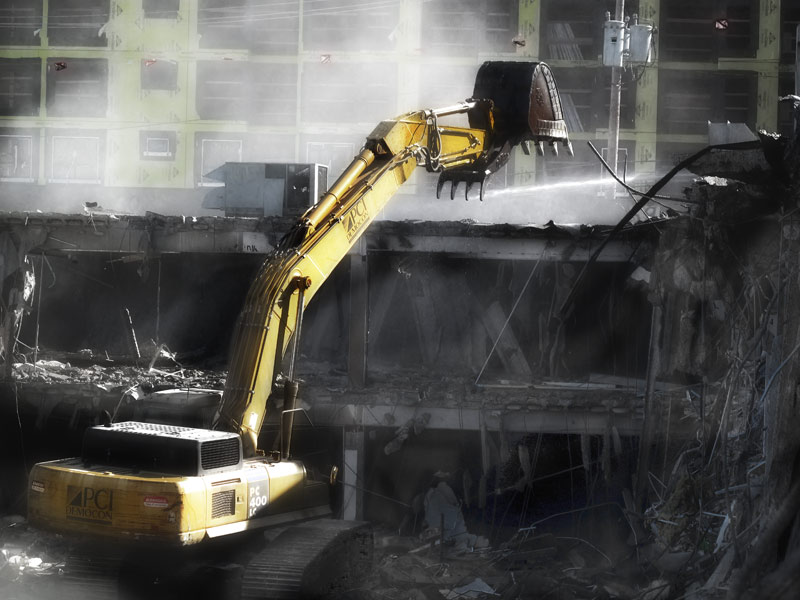
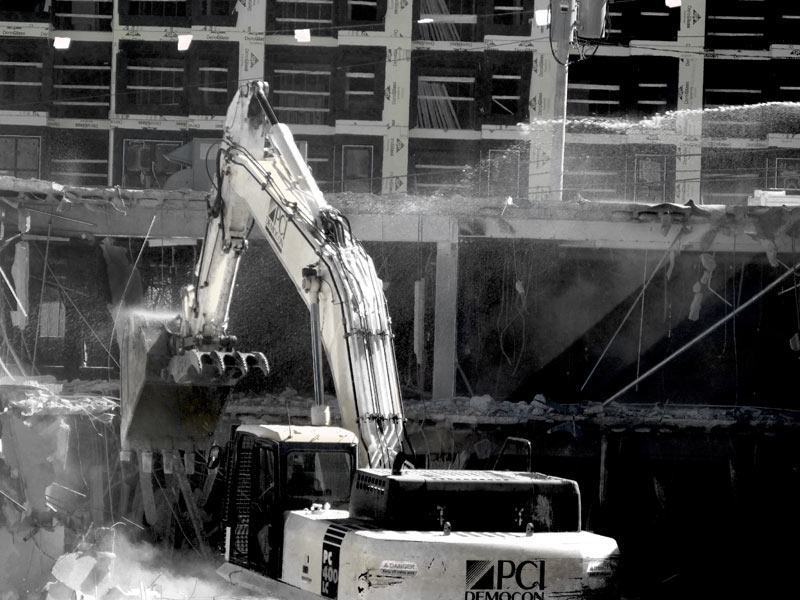
Demolition_Machine_Construction_Site

Demolition_Documentation_Westlake Construction Site

As I leaned over the pit water from the hoses drifted over the chain link fence and onto my arms. The air smelled of wet concrete and the first rains of autumn. Between the roar of traffic on one side and the grinding of machinery below I felt caught in a kind of still white noise in which all movement seemed precise and graceful as butoh. One man drove the excavator and one hosed from above, and it appeared that it takes only two men and one machine to dismantle what was an entire office building. I can’t weep for gargoyles or terracotta fleur de lis or bricks from the Great Seattle Fire. I have no feeling for this building. I have no idea what it looked like when it was a living breathing organism where some version of organized commerce took place beneath the now tangled guts of overhead lighting and heating ducts.
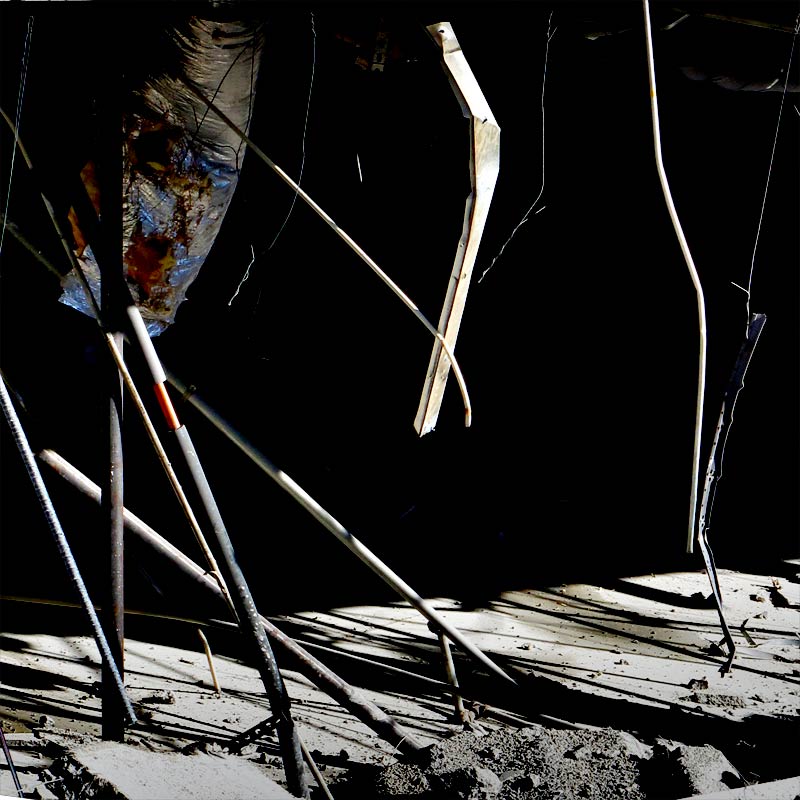
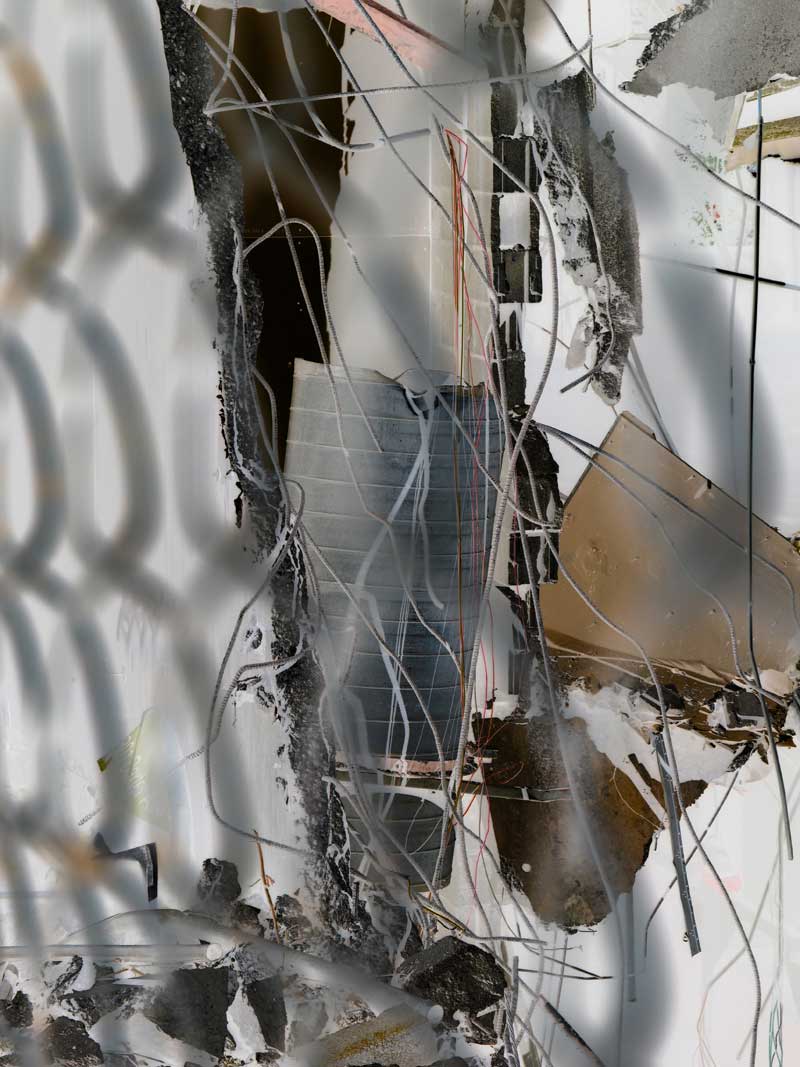
Cropped_Infrastructure_Westlake_Construction_Site

Decontruction_Infrastructure

On the other side of the street, from a building close to completion, I could hear the shouts of men operating a crane, hoisting huge stacks of wallboard to the twelfth floor.
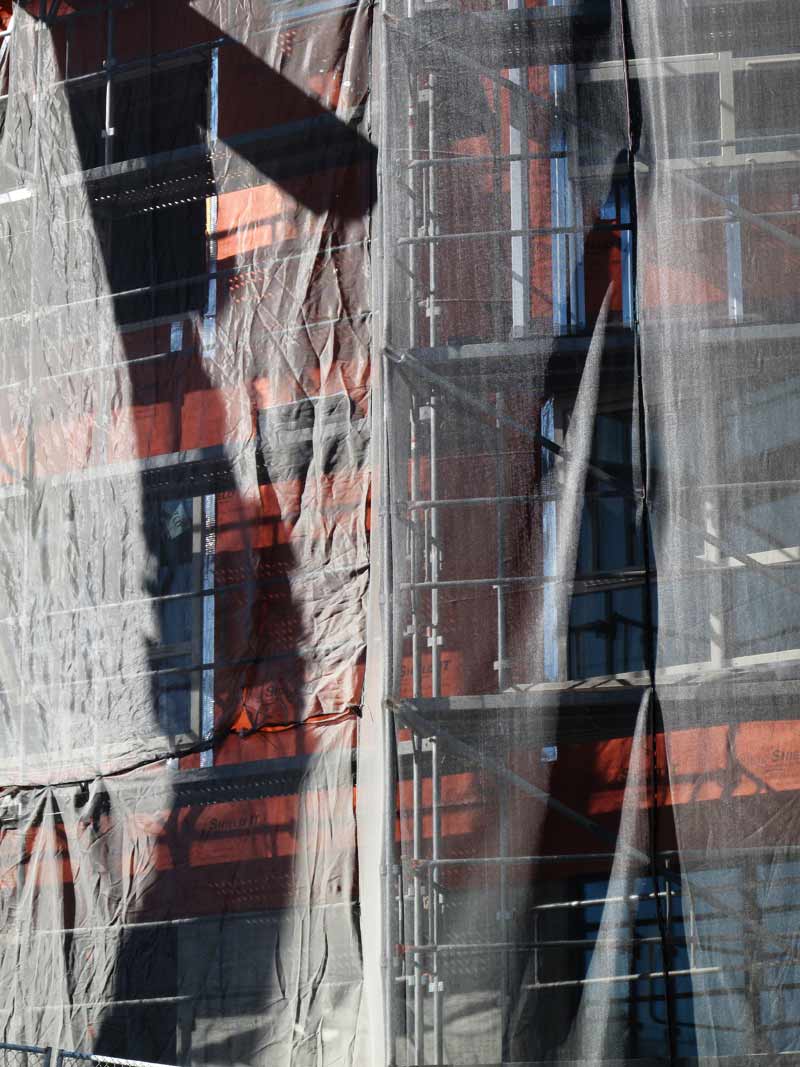
Drape_Scaffold_Construction_Site

Extreme change is a place and a story of its own. As society futurizes at a breathtaking pace I look alternately backwards and forwards, each glance more wrenching and extreme. I want to push pause. And I want to know if anybody else is in this with me. The Rolling Stone article makes me look through a new lens at trends in all kinds of art — visual, written, performance. In particular I wonder about spoken word. As I drive through the city my soundtrack is the radio. It seems to me I hear the art of storytelling evolving in very particular and exciting ways. Listen sometime to the dazzling and surprising Snap Judgement, Story Corps, and of course, the grand daddy, This American Life. In keeping with Taibbi’s point, these programs reach for a sense of the particular and the personal, the epiphanies of place and the equally poignant negotiations with its absence.  These storytellers are not packaging a by-gone era to sell it back to us as mood perfume or decoration. This is for real.

One day as I started photographing a site on Greenwood a man in a hardhat approached with an air of authority and asked for my papers. After some discussion I acquired permission to stand on the sidewalk and watch the ruins of one of Seattle’s last bowling lanes re-emerge as an apartment complex. We got to talking. The man had just come from working in Wyoming, in the fracking boom. He shook his head. “It’s a catastrophe in the making. We’re polluting the water, ruining the land and I couldn’t be part of it, I had to quit.” His passion and conviction surprised me. I gladly abandoned whatever preconceptions I might have about men at work.

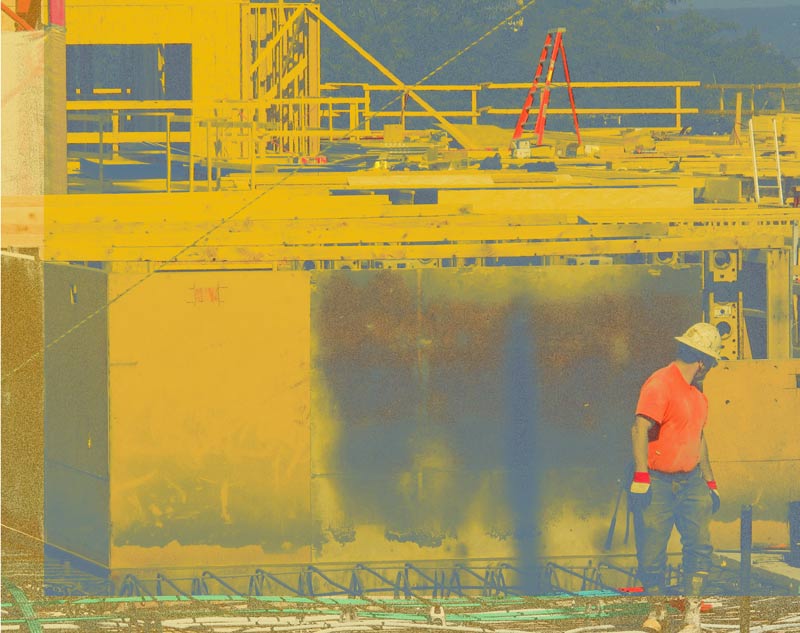
I have been focused on the abstract beauty of construction and deconstruction, and the human stories had not really entered my mind. Perhaps I’ve been playing Brahms on the battlefield, and  seeing only the slanting light, without considering the soldiers. I’ll leave you with another view. Call it a figure study, in orange.
Construction_Worker

All photos and text © Iskra Johnson

Filed Under: Construction/Reconstruction, Photography Tagged With: architectural photography, art & politics, art about place, construction site photography, Documenting Westlake, Matt Taibbi, radio shows about storytelling, Rolling Stone, Snap Judgement, Story Corps, This American Life

Notes from the Road: An Artist’s Trip to the Palouse

August 28, 2012 by Iskra 4 Comments

Sage_On_Map_EasternWashingtonWeeks after returning from Eastern Washington, I can’t seem to put the map away. From the corner of my eye I see the blue of the rivers and the lakes and the pale butter of desert and wheat. The whole map seems cast in the blue of the sky. It keeps me on the road even as I stand in my kitchen looking at weather the color of concrete. I read the names of the towns and put them together, knowing I would believe these people were real if I read them in a story: Clayton Ford, Lamona St. John, Gilmer Packwood, Randle Bingen, or just plain Quincy, with no last name. I want to have a cousin named Mayfield, and I want to marry a man named Dusty, which lines up along the road to Othello right next to Hay. To look at the map, to be in the map, they infuse each other – the blue sky the same color as these meandering backroads. The names of these places are equal parts dirt and aspiration. Yes to the beat up range horse and the saddle whose rosette tooling has worn flat from years of use, and yes to the Spokane carousel whose horses bloom with gilded chinoiserie.

Palouse-Road

Here in The West, in the upper left-hand corner formerly known as The Oregon Territories, (and before that as the land of the Nez Pierce, the Quinault and the Yakima Nations), we are divided by mountains. The usual associations of the compass don’t hold; The “East” is not know for its Buddhists and pagans and barefoot Occupiers but for small towns with even smaller churches with firmly held conservative beliefs. The West curls its lip at the East and mocks its Bible-quoting politicians and lack of tender regard for restoring the gray wolf. The East would prefer not to sponsor seawalls and fancy underground freeways and weddings in which both the bride and the groom are named Meg. And yet for all its smug urban insularity, people of the West regard the East with nostalgia and they carry a certain ache for its rural beauty. Out there is the land. No matter how thick the condominiums or how constipating the traffic or how high the price of a double latte vente with vanilla on the west side, the land is out there just over the pass saying: we have space and sky here for you. It’s saved for you and in the bank: beauty.

Every few years I make the pilgrimage across the Cascade mountains, to see if that space is still there or if I imagined it. This August I went with two artist friends to stay on a farm outside the farming town of Pomeroy and look after a herd of goats. It was delicious to be with companions who live to stop and to look. We packed a week of lunch, and checked our brakes for the long steep slope down the other side of the mountains.

HAYBALES-FOR-SALE
A clear sans serif always gets the message across.
Turn_Right_Road_Signage
Directional Signage. This is not Canada.

After a bit, beyond the too-big fruit stand that is now the only fruit stand, in the town of Thorp whose name seems too short and where the massive marquee offers “Antiques | Fruit” which just makes us think of raisins; after that bleak stretch where we think we’re not anywhere at all, we do reach The Road. Here finally is the ribbon of hills. The folding and unfolding waves of gold and green pivoting into creekbeads and scree and broken down things. Shimmering asphalt, blazing hairpins, the river, the barges, the Falls. White butterflies in pine trees. And a sudden leap into science fiction. When did the land become a wind factory? I turned my back and the Germans came and put these white giants, these three-armed industrial starfish on every horizon. What would Ray Bradbury think? Would he lie down beneath them in their protective mote of gravel and toast them with a glass of dandelion wine?

Two_Barns_PalouseThe_Road_PalouseThe_Old-Fashioned_WindmillThe_SciFi_Windmills_of_The_Palouse

Each windmill earns a farmer $10 thousand dollars a year. Each windmill powers 350 houses. Put that up against an idea,– a relic of an idea — of “landscape” or “natural beauty.” You’ll lose. And so we go farther east, to where the migration hasn’t taken hold, practicality and beauty are in harmony, and the highest best use of land is wheat and peas and these are just coincidentally lovely. [Read more…]

Filed Under: Photography, Recent Posts, Road Trips, Travel Tagged With: Artist journal of the Palouse, Artist Roadtrip, Blue Mountain Artisans Guild, Eastern Washington Landscape trip, Jennifer Carrasco, Mary Flerchinger, notes from the road, Palouse journal, Paula Gill, Pomeroy Washington, road signs, road trip journal, Steptoe Butte, the East-West Divide, visit to a goat farm, visit to Steptoe Butte, writing about the west

Three Days in the Sun: Cyanotype Workshop at The Stables

July 29, 2012 by Iskra 9 Comments

Cyanotype_At_The_Stables
© Iskra Johnson

The Stables is the quietest place I have ever been. You can hear a twig drop in the woods, and a horse eating a buttercup. In between, complete, breathtaking stillness. Situated high on the southwest side of Orcas Island, this 25-acre ranch and creative compound hosts workshops in a variety of arts and crafts taught by the resident artists and invited guests. The simultaneous sense of vista and retreat makes for a very special place for art and reflection.

This July I signed on with my sister, Cassandra, and 17-yearold niece Zoë for a three-day workshop in cyanotype. My sister and I had spent early years growing up on a ranch, and to be together quite literally in a stables, sleeping in a loft above, sent us both into states of unexpected recollection. Every morning we looked out on two chestnut horses and followed their graceful ambulations across the pasture. The tooled leather and haymow, the 4-H, the riding rink, the coyotes under the moon and the back forty of our pasts tumbled into the present everywhere we turned. My niece, not yet of an age for elegies, lovely in pigtails and grave and hilarious by turns, focused on her senior year project in all things photographic. She proceeded to make one artlessly perfect composition after another. Note to self: make no helpful design suggestions when a true artistic gift is at hand.

ZoeTwoCyanotypesOneWithTea-Bath
Two of Zoë’s Prints, the lower one has been toned with tea

I had planned originally to work with my existing themes of architectural photography, and had spent days making negatives. At the last minute I threw two birdcages in the car. This turned out to be a very good idea. Within hours on the first day I could see that this process of cyanotype is an alive thing, a way to paint with the sun and your surroundings, an opportunity to toss out your preconceptions and open the door to the unexpected. Noted Seattle artist and cyanotype expert David Simpson taught us, and nudged and pushed us through three days of testing our limits. Although he had encouraged us to bring objects we also used what we found on site: crumpled wire, thistles, chainsaws, daisies, ferns. We laid these things on glass or directly on coated paper. Our fourth workshop member, printmaker Lynda Swenson, experimented with printing on maps and existing etchings and woodcuts.

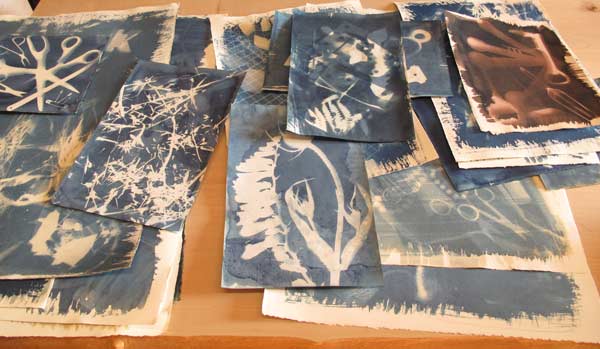
Cassandra_Cyanotypes_On_Various_Papers
Some of Cassandra’s prints.

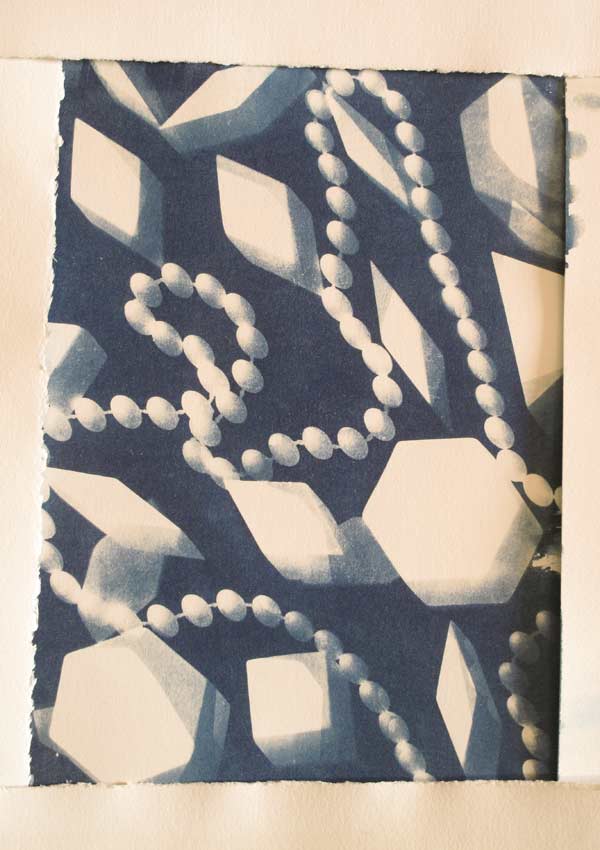
Upper right brown and black print shows how fabulously the Artistico works with tannic acid toning. Below, a composition with three dimensional blocks and pearls, testing cropping. The actual print is not this yellow. The photo was taken with warm light from the walls of the stables reflecting onto the surface. I would love a skirt with this printed on it!

Cassandra_Cyanotype_With_Pearls

Close-up_of_Linda_Swenson's_cyanotype_on_a_Map
Close-up of Lynda Swenson’s cyanotype on a map

In the first step we coated our paper with solution in a darkened stable under a red safe-light. When ready we dashed from the darkroom to the outside laboratory where we slid the paper under existing arrangements or began lightning fast compositions, lifting or placing objects for different effects. We all had various timing devices, and at times it looked like a circus casino, or perhaps a camp for people with attention deficit disorder. We rushed in and out of the barn, lifted and placed objects, stared at our paper variously counting outloud, watching a cellphone or a wristwatch, or drifting into conversation — “What minute was I on???” And then (this was the best part) we threw the paper into a kiddie wading pool to fix and finish developing.

Art_In_The_Pool_Fixing_a_Cyanotype
Just accept the octopus into your heart…and agitate carefully to avoid the dreaded water bubble spots–they cannot be removed.

Some things I learned:

  1. Paper: Although many sites recommend Stonehenge as an ideal paper I would like to sell you a bridge to nowhere. I have fifty sheets of this stuff and we universally loathed it. No depth. A pale obnoxious blue. Also no watermark and cheap—what was I thinking??
  2. Rives BFK takes on odd shades of brown under some circumstances, which sometimes adds a pleasing element. The cyanotype solution tends to bead up and it is very hard to know if you have the edges of your paper covered in the semi dark.
  3. 400 pound Strathmore rag bristol mottles. It also can delaminate in the bath. But, you can then recoat the separated sheets and use the mottled tints as background to create lovely new images. Some of my sister’s best pieces were created this way. They have a wonderful vintage quality and tonal depth.
  4. Fabriano Artistico hotpress provides phenomenal fine grained exposures and takes toning elegantly, you can created a black and brown duotone with crisp luminous whites. I wish I had bought fifty sheets of THIS. Rives worked best with the few photo negatives I tried. I did test strips, and timing through clamped glass was one half to one third of that needed for objects (ie. For negatives, an average of four minutes in hot July sun.)
  5. Water: The Orcas water comes from a well and has minerals in it. This may be why certain prints took an amber cast after several coatings. Cyanotype is the art of variables. Washing and fixing prints in city water with chlorine could lead to completely different results. I had mysterious perfectly round spots on my first three or four prints, which appeared only after the water bath. It took a lot of detective work, but we finally figured out that it was bubbles formed by not immersing the paper fast enough and completely enough—and do immerse the paper face down.
  6. Adding peroxide to the water bath: you get blazing blues. We didn’t test definitively enough to know if the blues lasted and were as dark or darker than cured prints, but we decided it might be kind of a cheap trick.
  7. Time: Make no final decision on anything until prints have dried and oxidized for at least 24 hours. They can darken drastically.
  8. Random magic: Yes, you can expose while paper is still wet, and it leads to beautiful effects like watercolor. You can also paint with solution under the sun. The solution will change and change as you paint, losing potency as it is exposed. There is absolutely no need to take a meditation workshop or study impermanence with a master from the East. Just pour cyanotype onto paper under the sun and spend some days watching it dry. Change is the only constant.
Painting_With_Light_Cyanotype_Experiment
Painting with light, cyanotype experiment

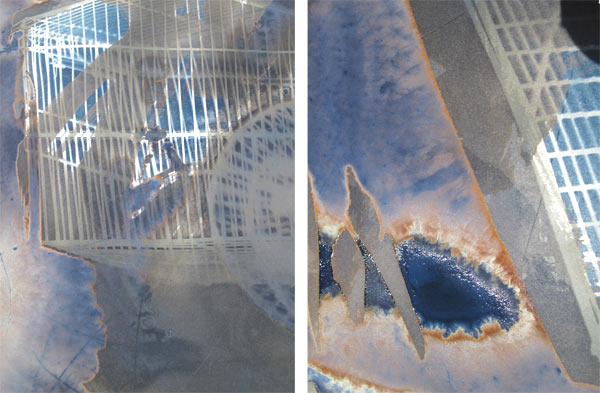
Above, a piece in progress. I painted under bright sun, adding new solution. As it dried it turned strange shades of rust and pink and two new shades of blue I hadn’t seen before. Then it all disappeared in the wading pool and became something else.

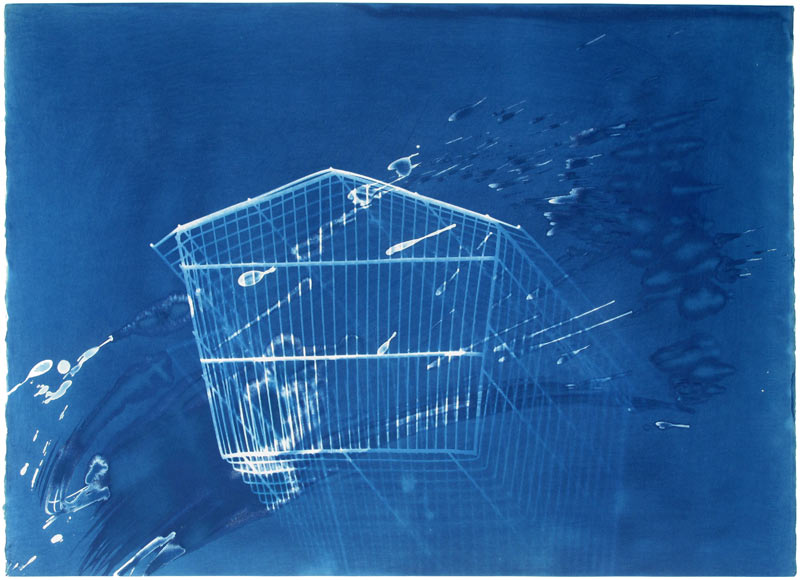
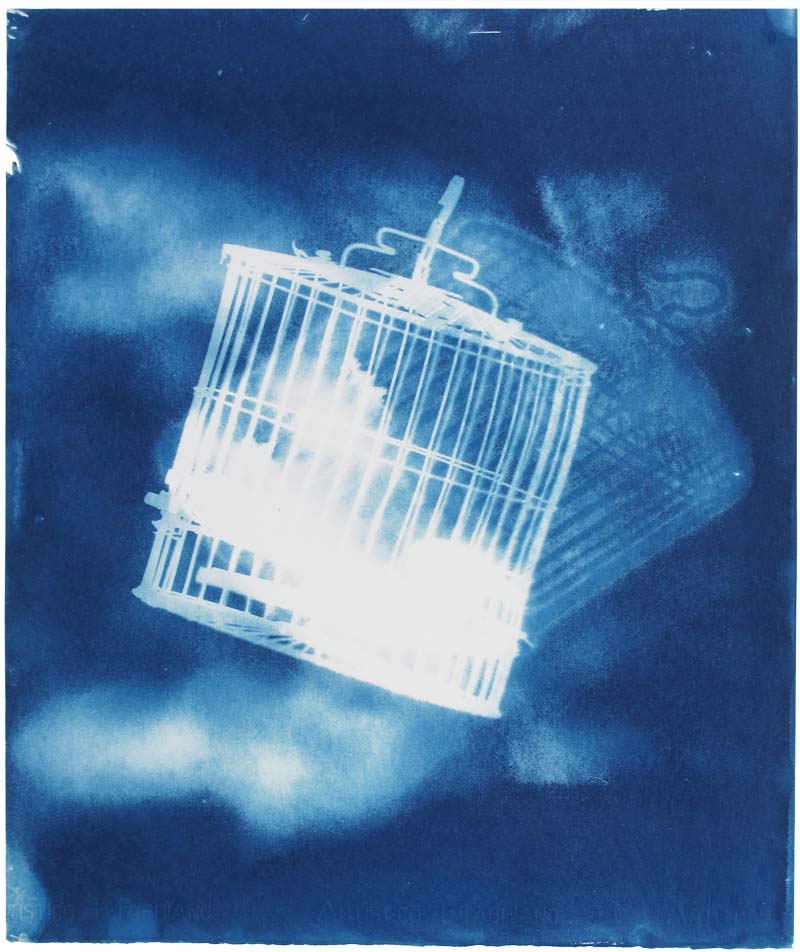
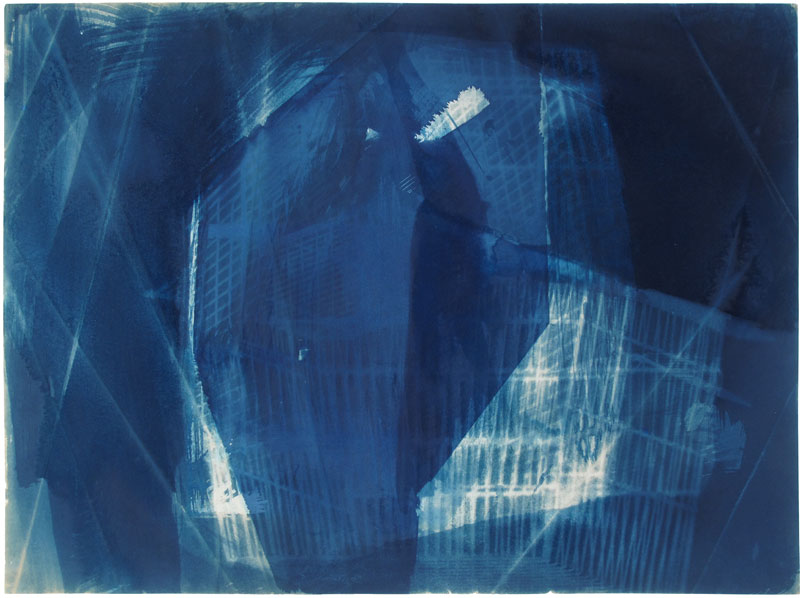
One of the most promising experiments I did involved folding paper while it was wet. I do wish I had figured out the cause of the mysterious round spots before I did “Origami Cage”, but I am including it here because I think it’s interesting. I can’t tell you how great it felt to completely beat up a piece of paper. When I wake up in the morning one of the first things I see when the sun is out is the shadow of birdcages cast onto the wall. I have tried off and on for ten years to capture them in some way. I think they finally found their home.

Bird_Cage_One_Cyanotype
Bird Cage 1, 16″ x 22″, Cyanotype on Fabriano Artistico © Iskra Johnson
TiltedCageCyanotype
Tilted, 22″ x 16″, Cyanotype on Fabriano Artistico, © Iskra Johnson
Bird_Cage_Cyanotype_2
The Cloud, 22″ x 16″, Cyanotype on Fabriano Artisitico, © Iskra Johnson

Architectural-CyanotypeDetail

Origami_Cage_Cyanotype
Origami Cage, 16″ x 20″ Cyanotype on folded Rives BFK
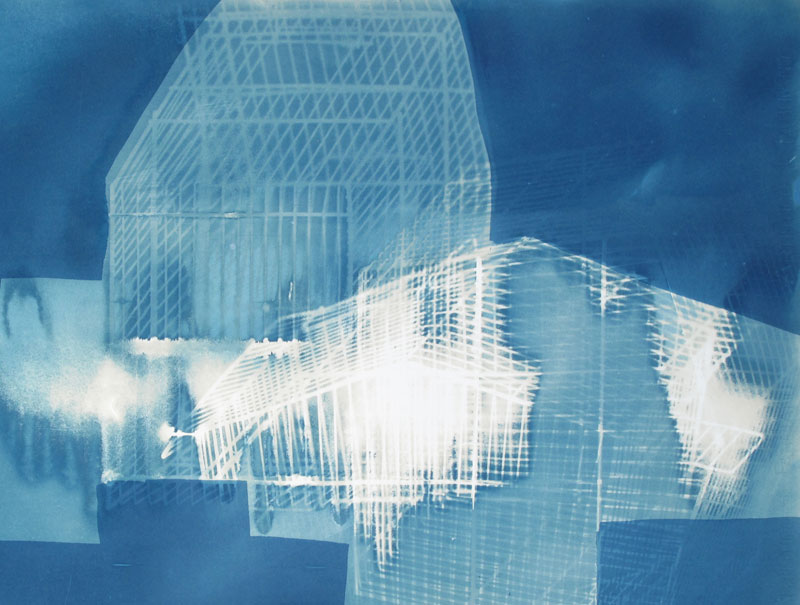
Deconstruction1_Cyanotype
Deconstruction, 17″ x 23″, Cyanotype on Fabriano Artistico, © Iskra Johnson

And, a couple of links. You can find out everything you ever want to know about cyanotype and alternative processes at Alternative Photography.com. And don’t miss David Simpson’s work at Photographic Wanderings at Lisa Harris Gallery opening August 2.

Filed Under: Photography Tagged With: alternative photography techniques, best papers for cyanotype, composing with objects, cyanotype workshop, Dvid Simpson, painting with light, The Stables on Orcas Island

Heading for a Blue World

July 23, 2012 by Iskra Leave a Comment

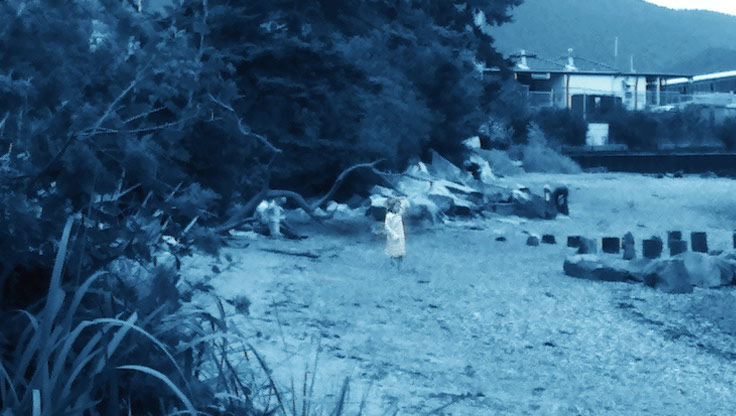
CyanotypeGirlAtTheShore

I took this picture from the beach while waiting for the ferry, heading out to Orcas Island for a three-day workshop in cyanotype. I had no idea my phone could see in blue, but I stumbled onto the filter and am getting a head start. The real thing soon!

Filed Under: Photography

Thoughts on Photography and History: Ken Rosenthal, Takashi Arai, the Real and the Unreal

July 15, 2012 by Iskra 2 Comments

ArtLibraryEntryGothicArch
Entry to the Art Library, with artist-applied faux-historical “Instagem”™ effect © Iskra Johnson
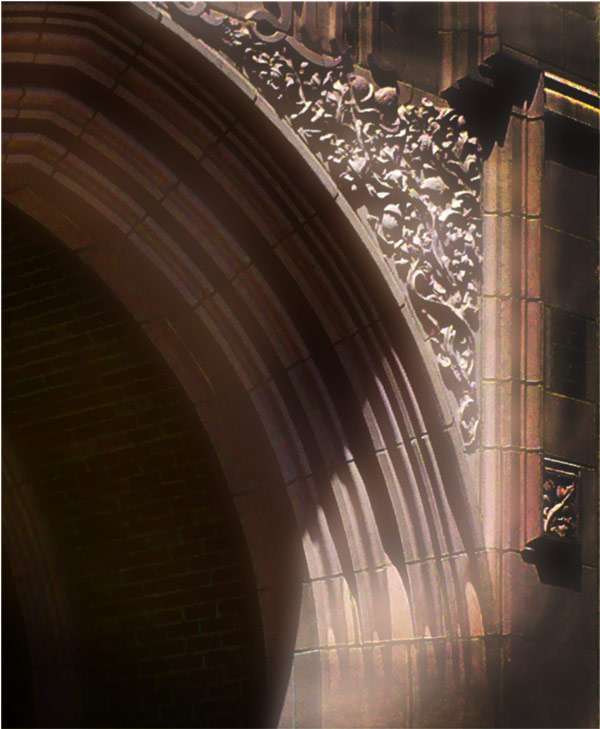
“…the camera does more than just see the world; it is also touched by the world. Light bounces off an object or a body and into the camera activating a light-sensitive emulsion and creating an image.”–Geoffrey Batchen

“touch is the most demystifying of all senses, unlike sight, which is the most magical.” — Roland Barthe, Camera Lucida

On Friday I became an art history nun and went into the cloisters. The University art library is not the place I recall from decades ago, but imagining persists. I ignore the flourescent tubes and the blinds drawn against the natural light of the clerestories and am grateful at least for the shadows of leaves cast by the trees. I pretend these silhouettes are a vintage theorem painting being painted again and again by the wind and the sun. I inhale the Dewey decimal system and its attendant odor of pulp and glue, and feel a calm and translucent habit settle about my shoulders. In this funnel of starched linen, a scalloped awning above my eyes, I can sink into pictures and footnotes and the zigzag worry beads of the alphabet. Some call this reading.

We live in a culture so laminated with derivation and appropriation that it is very easy to forget that at some point there was a “real” on which the derivations are based. An entire generation will grow up thinking that an Instagram is a photograph. “Snap a photo with your mobile phone, then choose a filter to transform the image into a memory to keep around forever.” “Retro” is a station on Pandora. “Retro” is, basically, a “filter.” But once long ago there were actual steam engines and eye glasses made of glass and men went under a tent of black canvas and made you sit still forever to get your one very precious portrait taken. I am so taken with these portraits. The person is dressed invariably in shades of umber, against an equally umber backdrop. She or he leans pensively, stiffly (whilst waiting an interminable ten to thirty minutes) until the exposure is complete. If you want to know what this sense of time is like, and how it sounds, take a peek at this extraordinary work by Takashi Arai.

Mirrors in Our Nights, Takashi Arai
From “Mirrors in Our Nights” by Takashi Arai, contemporary daguerreotypes of Japan immediately after the earthquake, with audio of the sounds heard during the very long exposures. You may need attention deficit medication while watching this ten minute video, but it is worth it.

In many historical daguerreotypes the sitter gazes at another daguerreotype in its lovely filigreed case, or poses the case facing out at the camera, creating a loop of self-referential mirrors. Is the person’s mouth twisted in a prematurely elderly grimace from the effort of trying to memorize the tiny image in their hand? Of trying to remember “who was this guy’s name who I might have been in love with at some point?” Or is it the tedium of south Dakota and the fly buzzing in the August heat and the fact that the pose must be held for half an hour? I find these pictures enchanting. The silver on glass does indeed cause the image to float, real and unreal, even in a reproduction.

Only later in the day, gazing at passersby at the Lake, am I startled to see that a glass case of identical size is being held by almost every person. And that they are gazing at this luminous device with rapt attention, admiration and even hypnotism, albeit in full technicolor and not sepia. They are also, in the style of modern liberations, moving their heads without concern, and emoting. And in many casts of light they are seeing their own face reflected over the latest status update on Facebook, which no doubt includes….Instagram photos. Talk about mirrors.

If a photograph was originally intended as an aid to memory, and as a document of the real, what is it now? How can you remember when you have no time in between images to forget? How many millions, trillions, billions of images will we be subjected to in our new modern lifetime? If we live in a world of endless mirrors, but without a mediating lense, light reflects but we do not necessarily absorb it, much less have the capacity to reflect upon it.

I have been dwelling on Batchen’s quote

“…the camera does more than just see the world; it is also touched by the world. Light bounces off an object or a body and into the camera activating a light-sensitive emulsion and creating an image.”

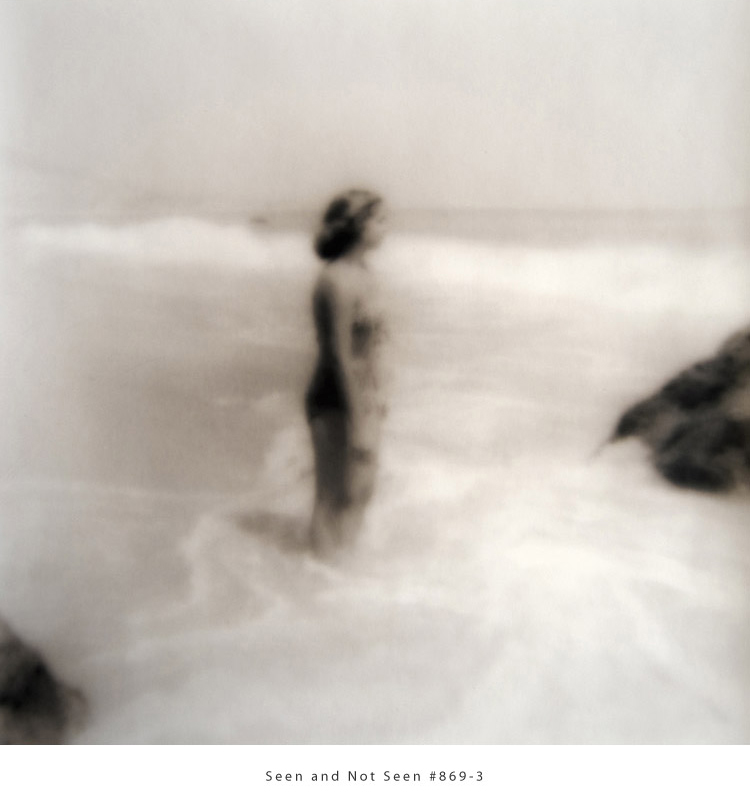
This idea remains magical. You can easily lose sight of it when you spend hour upon hour in front of a computer revisiting images that are now simply a pixel representation of a moment of touch. Most modern photography (and conversation about it) lacks attention to one elemental factor: emulsion. Invisible on screen or in digital prints, it is the thinnest of membranes, providing the alchemical medium between the world of touch and the world of sight. The essence of this was brought home to me during a lecture, “Seen and Not Seen,” I attended at the  Pacific Northwest Center for Photography on Friday. This enchanted evening in the dark viewing the work of Ken Rosenthal provided the perfect elaboration of everything I had absorbed in the library hours earlier. The primary body of Rosenthal’s photography looks backwards into memory, and is based on personal and historical photographs of his own family. All of the work until very recently relies on darkroom methods for printing. The sense of the physical and intimate path of light comes through very strongly.

SeenAndNotSeen#869-3
© Ken Rosenthal

His methods are exacting and customized, and not entirely revealed. When I see these images I feel transported not just to the past of the event documented, but into the laboratory in which the image was made. One of Roland Barthe’s essays which I read this week describes at length the sounds of a photograph. The verbal description alone, placed next to the seemingly inert photographic reproduction of a horse walking in fog, conveys a sense not just of sound but of air and smell and cinematic immediacy. As I write this, sitting at a computer, having spent all of yesterday “developing” photographs in Photoshop, the convergence of Barthe and Rosenthal, like the bite of a madeleine cake catapults me into another time. I am on the farm in the darkroom, my eight-year-old nose bumping my father’s elbow, watching as he develops prints of an Arabian horse. It is a summer day in July, and we are in the only cool place in the uninsulated farmhouse, in the basement where he tucked a bench and an enlarger in a narrow hall behind the washing machines. I can hear the rattle of the film canister, the click of the enlarger moving up and down, the huf-huff of the dust bellows, the tongs knocking against the developer tray. The red light is terribly mysterious and exciting, and I know at any moment I could ruin everything by opening a door. And then there is the moment when my father lifts me up and stands me on a chair so I can see the image emerge, ghostly, intangible, then gradually an eyelash, a glint of bridle, the unmistakeable ridge of a mane rising up white against a dark unclouded sky.

What Rosenthal achieves in his approach to his own very personal subject matter is not “just personal.” It is about memory and seeing itself.

And it resonates in a universal way with anyone who has ever held a family photograph in their hand, run their fingers along the scalloped edges and wondered about the slightly out of focus and scratched up ancestors buried in the surface. As technology changes, as emulsion and eventually even the memory of emulsion vanishes, as “family albums” come as pre-designed digital templates with faux photo-corners and can be “downloaded” in seconds, although never actually “held,” as vintage or as for that matter everything becomes a “look” referencing another “look” I wonder how his work will seem in twenty years. What filters will viewers see it through? The metaphoric facts of how we see will not change. Memory will “blur” fact.  The eye will continue to alternately focus on one thing and the whole, moving back and forth in time. Light will continue to refract, bounce, enter, transform. Perhaps the early technologies were closer to revealing the unseen than our modern ones in which part of the achievement is the pristine absence of gears and wheels. You will find many contemporary images mimicking the look of the ground-breaking running horse sequences of Muybridge but few of them mimic his idea, which was that he was showing something the eye could not see.

I feel a great solidarity with the artists today exploring alternative photographic processes. All of these methods attempt in some way to recapture the mystery of photography’s origins. Artifact, relic, moment, surface, presence. Something beyond the ever-unpluggable computer screen or the printed facsimile of the screen. An object that takes you believably into the moment both as you create it and as you witness its record. If we are using primarily digital technologies it is an open question if we can transcend them and find in the pixel a convincing fingerprint.

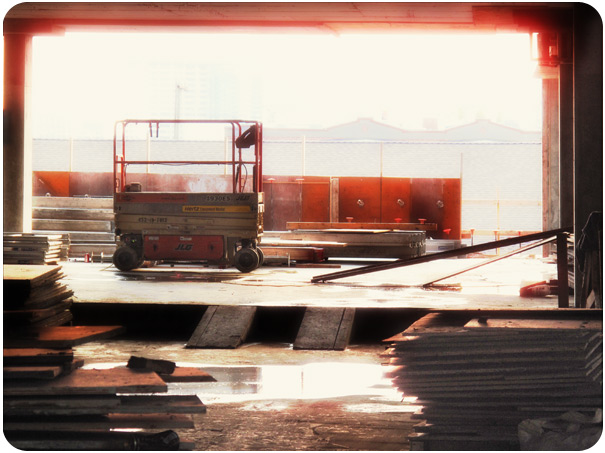
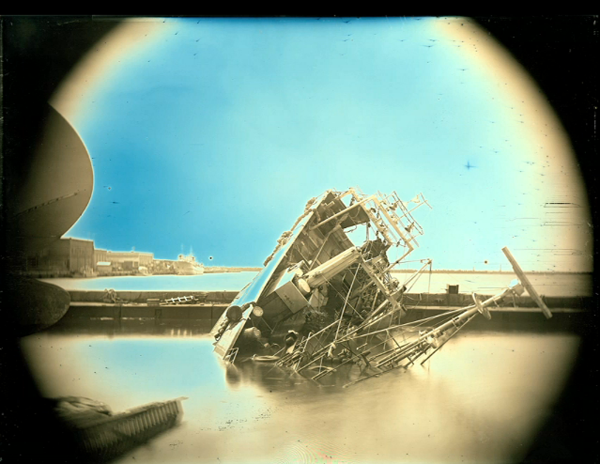
When I left Rosenthal’s lecture at nine o’clock the last of the Siberian forest fire sunsets still hung in the Seattle sky. Who would have guessed these translucent clouds and mesmerizing pinks come courtesy of Russia? The air shimmered with softness and unexpected warmth as I pulled my car over at a construction site. I propped the camera into chain link. Low light, no tripod. Under these  circumstances I don’t usually think about the physicality of light, of how the camera is “touched by the world,” I tend instead to curse the limits of resolution and sensors and my human hand. But for this lantern hour as I shot into the deepening dusk, I let those thoughts go. It could have been another time: the world was young.

ChineseGate_ConstructionSiteDocumentation
Site Documentation: The Chinese Gate © Iskra Johnson
 

Filed Under: Art Reviews, Photography Tagged With: alterntive photography, essays on photography, ken rosenthal, Takashi Arai, thoughts on dagerreotype

  • « Previous Page
  • 1
  • …
  • 4
  • 5
  • 6
  • 7
  • 8
  • …
  • 12
  • Next Page »

Join Iskra’s Mailing List

Don't miss a thing! Subscribe to receive show announcements, first peek at new work and my semi-monthly blog by email. I primarily use the blog for news and updates but by signing up you will also receive the occasional newsletter and special offers for items in my shop.

Iskra Fine Art Blog

the creative process | conversations with artists | the contemplative impulse in art

Instagram

[instagram-feed num=6 cols=2]

Featured Posts

  • How to Purchase Artwork from Iskra Fine Art
  • About This Blog
  • New Directions in Contemplative Art: Conversations with Artists
  • What is a Transfer Print? (Artist Statement)

Categories

  • 100DaysOfTheSpaceBetween
  • Architecture & Sense of Place
  • Art Reviews
  • Art Sales
  • Artist Studio Visits
    • The Mystic Muse: Artists Working in the Contemplative Traditions
  • botanical art
  • Collage
  • Construction/Reconstruction
  • Current Affairs
  • Digital Collage
  • Drawing
  • Essays
  • Featured Post
  • Greenlake
  • Iskra Shows, Upcoming and Past
  • Iskra Sketchbooks & Journals
  • Iskra Writing on Medium
  • Living With Art
  • Meditation & Buddhism
  • Mixed Media
  • Music
  • Object Lessons: Essays and images inspired by "A History of the World in 100 Objects."
  • Painting
  • Photocollage
  • Photography
    • American West Landscape Photography
  • Poems
  • Press
  • Print Sale
  • Prints
  • Recent Posts
  • Road Trips
  • Social Media for Artists
  • Teaching
  • The Alaska Way Viaduct
  • The Garden
  • The Spiritual in Art
  • The Street
  • The Water Tower Project
  • Transfer Prints
  • Travel
  • Uncategorized
  • Watercolors

Archives

Search

Connect on Facebook

Iskra Fine Art Facebook Page

Creative Inspiration

  • Alternative Photography
  • An Artist's Retreat
  • Anonymous Chinese Textile Genius: Moo Won
  • Chocolate Is A Verb
  • Contemplative Art Process: Danila Rumold
  • Eva Isaksen
  • Old Industrial Japan
  • The Altered Page
  • The Heart Sutra Loop
  • The Patra Passage

Galleries for Contemplative Art

  • ArtXchange Gallery
  • Seattle Asian Art Museum

Links

  • CollageArt.org
  • Iskra at SAM Gallery
  • Iskra Fine Art on Houzz
  • Seattle Art Museum Blog
  • Seattle Artist League
  • Seattle Print Arts
  • Seeing Fresh: Contemplative Photography
  • The Painter's Keys

What I'm Reading: Online Magazines and Books I Love

  • 16 mi.
  • Essays by David Whyte
  • Evening Will Come: Poetry
  • Hyperallergic
  • Painter's Table
  • Shu: Reinventing Books in Contemporary Chinese Art
  • Streetsy
  • The Original Van Gogh's Ear Anthology
  • Tricycle Magazine
  • Unincorporated Persons in the Late Honda Dynasty
  • Vanguard

Let’s Connect

  • Contact Iskra
  • How to purchase artwork
  • Iskra Fine Art Blog : The creative process, conversations with artists, the contemplative impulse in art

Join Iskra’s Mailing List

Don't miss a thing! Subscribe to receive show announcements, first peek at new work and my semi-monthly blog by email. I primarily use the blog for news and updates but by signing up you will also receive the occasional newsletter and special offers for items in my shop.

  • Facebook
  • Instagram
  • Pinterest
  • Twitter

All Images Copyright © 2026  Iskra Johnson · Site by LND · WordPress